
Remembrance Day in Canada: Honouring Those Who Served
Table of Contents
- Why We Celebrate Remembrance Day in Canada
- The Red Poppy Meaning and Why It Endures
- Two Minutes of Silence: A Nation Pauses
- Remembrance Day Canada: How Observance Varies by Province and Territory
- Honouring Canadian Veterans: Stories Beyond the Stereotype
- Remembrance Day Activities for Children and Families
- Wearing Your Values: Meaningful Ways to Mark the Day
- Frequently Asked Questions
Last Updated: October 20, 2026
Why We Celebrate Remembrance Day in Canada
Every November 11, Canadians stop what they are doing and hold two minutes of silence. That pause is the heart of remembrance day in Canada, a national observance honouring the more than 100,000 Canadians who have died in military service and the veterans still living with what war leaves behind.

The date is not arbitrary. It marks the armistice that ended hostilities in the First World War, signed to take effect at 11 a.m. on November 11, 1918 (Remembrance Day | 2. History of Remembrance Day). According to Veterans Affairs Canada's Remembrance Day resources, the national ceremony at the National War Memorial in Ottawa remains the centrepiece of the observance each year.
The Eleventh Hour, the Eleventh Day, the Eleventh Month
The phrase "the eleventh hour of the eleventh day of the eleventh month" comes directly from the armistice terms. Fighting stopped at that precise moment, and the guns of the First World War finally fell silent.
That is why ceremonies across the country begin just before 11 a.m. The timing is the message: the hour itself is a memorial. Communities gather at cenotaphs, wreaths are laid, and the Last Post sounds before the silence begins.
The Red Poppy Meaning and Why It Endures
The red poppy is the symbol of remembrance because these flowers grew across the battlefields of Flanders after the fighting churned the soil (The Poppy).
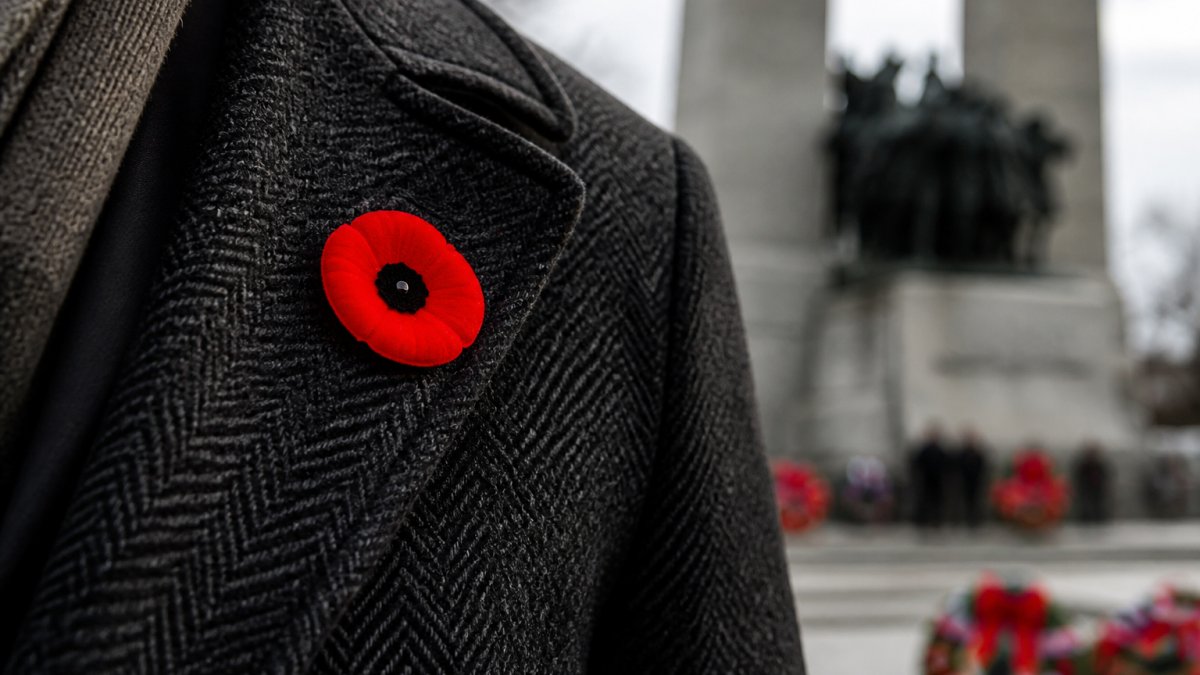
The red poppy meaning is simple and stubborn: it stands for sacrifice, and for the duty to remember. The Royal Canadian Legion distributes poppies each fall, with donations supporting veterans and their families.
From Flanders Fields to the Lapel
McCrae wrote the poem in 1915 after burying a friend. It became one of the most recognized war poems in the English language, and the poppy spread across the Commonwealth as a symbol worn in November.
Some people choose a white poppy to emphasize peace. Others wear the traditional red to honour those who served and sacrificed. Both are personal choices, and neither requires explanation.
Two Minutes of Silence: A Nation Pauses
The two minutes of silence is a period of quiet reflection observed at 11 a.m. on November 11, when Canadians stop to honour those who served and died.
What happens during those two minutes is personal. Some people stand at a cenotaph. Some pause at a desk. Some hold a photograph of a grandparent.
If you are at work or in class when 11 a.m. arrives, you do not need a ceremony to participate. Standing quietly wherever you are is enough.
Remembrance Day Canada: How Observance Varies by Province and Territory
Remembrance Day is one of the few Canadian observances where the answer to "is it a day off?" depends entirely on where you live and who you work for. That patchwork is the single most common source of confusion every November, and it is worth spelling out plainly.
Statutory Holiday Status Across the Country
Here is how the day is generally treated, based on provincial and territorial labour standards. "Statutory holiday" here means the day is recognized in employment standards for most provincially regulated workplaces; it does not guarantee every employee gets the day off.
Jurisdiction |
Statutory Holiday? |
Notes |
|---|---|---|
Ontario |
No |
Not a provincial statutory holiday; federal workplaces and some employers observe it |
Quebec |
No |
Not a statutory holiday; ceremonies are still held widely |
Manitoba |
No |
Special provisions apply in some cases; check Manitoba labour standards |
Nova Scotia |
No |
Not a statutory holiday under provincial rules |
British Columbia |
Yes |
Provincial statutory holiday |
Alberta |
Yes |
Provincial statutory holiday |
Saskatchewan |
Yes |
Provincial statutory holiday |
Newfoundland and Labrador |
Yes |
Provincial statutory holiday |
New Brunswick |
Yes |
Provincial statutory holiday |
Prince Edward Island |
Yes |
Provincial statutory holiday |
Northwest Territories |
Yes |
Territorial statutory holiday |
Nunavut |
Yes |
Territorial statutory holiday |
Yukon |
Yes |
Territorial statutory holiday |
The Federal Layer Most Guides Skip
Federally regulated workplaces, banks, telecommunications, air and rail transport, and the federal public service among them, observe Remembrance Day as a holiday regardless of the province they operate in. That means two coworkers in the same city can have different answers depending on who regulates their employer. If you are unsure, the practical test is whether your workplace falls under provincial or federal labour law, not which province you are standing in.
What Varies Beyond the Day Off
Holiday status is only one layer. Municipal ceremonies, legion branch events, and school assemblies vary just as much. Some communities hold services at a cenotaph at 11 a.m.; others hold an evening gathering; some hold both. The national ceremony at the National War Memorial in Ottawa is broadcast and streamed each year, which makes it the reliable option when no local service is nearby.
Rules can change, so confirm with your province or territory's labour standards for the current year before making plans around the day.
Lest We Forget Poppy T-Shirt – Women's Remembrance Day Tee →
Honouring Canadian Veterans: Stories Beyond the Stereotype
Honouring Canadian veterans means more than picturing one kind of soldier. Canadians who served came from every region, background, and walk of life, and their stories are wider than the old photographs suggest. The most respectful way to mark November 11 is to learn at least one story you did not know before.
Indigenous Service
Indigenous peoples have served in Canada's military in large numbers across every major conflict, often despite barriers at home. In the First World War, thousands of First Nations men enlisted even though many were not yet recognized as full citizens and some faced pressure from Indian agents against volunteering. In the Second World War and Korea, Indigenous service members continued to enlist, and several became decorated.
Black Canadians in Uniform
Black Canadians served in segregated units in earlier wars and in every branch since. In the First World War, the No. 2 Construction Battalion, raised in Nova Scotia in 1916, was the first and only predominantly Black battalion in Canadian military history, formed after Black volunteers were turned away by other units. Its members served in France, and the battalion's history is now part of the public record.
Women in Service
Women served as nurses in both world wars, in support and administrative roles, and eventually in combat trades as the Canadian Armed Forces opened roles to women through the late twentieth century. The nursing sisters of the First World War served close to the front lines, and their diaries and letters are among the most direct accounts of what the war cost.
A Practical Way to Honour That Breadth
Pick one story you did not know before November 11 and read it. Veterans Affairs Canada maintains records, biographies, and unit histories worth reading, and the Canadian War Museum's online collections are another reliable starting point. Learning one name and one unit is a small act, but it is the kind of act that keeps remembrance from becoming a slogan.
A ceremony at a cenotaph honours everyone who served. Learning a specific story honours one person, and the two practices reinforce each other.
Remembrance Day Activities for Children and Families
Children understand remembrance best through doing, not lecturing. The goal is to help them connect a symbol or a silence to a real person and a real idea.
At Home, at School, and in the Community
- Read "In Flanders Fields" together and talk about what the poppies in the poem were growing among.
- Make a poppy craft from paper or felt and pin it to a coat or backpack.
- Attend a local ceremony at a cenotaph, legion branch, or community centre.
Schools often hold assemblies on the last school day before November 11. Ask your child's teacher what the class is doing so you can reinforce it at home.
Wearing Your Values: Meaningful Ways to Mark the Day
Some people mark November 11 by attending a ceremony. Others wear their remembrance quietly, in a piece of clothing they can put on again and again. Both count.
We designed our Lest We Forget Poppy T-Shirt as a fitted women's polo in premium pre-shrunk cotton, with a subtle red poppy and ivory-gold lettering on the left chest. The Keepsake Remembrance Day Blanket offers another way to bring the tradition home: soft fleece with embroidered poppies, machine washable, and available in sizes small to large.

Both are made on demand, which means they are created when you order. With November 11 fast approaching, now is the time to buy so your piece arrives before the day. Explore the True North Collection for more ways to wear remembrance with care.
Frequently Asked Questions
Why do we celebrate Remembrance Day?
Canadians observe Remembrance Day to honour the men and women who served in the military and to remember those who died in war and peacekeeping. The date marks the armistice that ended hostilities in the First World War at 11 a.m. on November 11, 1918. More than 100,000 Canadians have died in military service, and the national ceremony at the National War Memorial in Ottawa, along with local cenotaph services, keeps that sacrifice visible. It is a day for gratitude, reflection, and passing the tradition to younger generations.
What is the difference between Veterans Day and Remembrance Day?
Veterans Day is a United States observance held on November 11 that honours all American veterans. Remembrance Day is the Canadian and Commonwealth commemoration that focuses on remembering those who died in service, while also honouring all who served. In Canada, the day includes the two minutes of silence at 11 a.m., the wearing of the red poppy, and ceremonies at cenotaphs. The shared date reflects the same First World War armistice, but the tone and traditions differ.
Is November 11 a statutory holiday everywhere in Canada?
No. Remembrance Day is a statutory holiday in most provinces and territories, but not in Ontario, Quebec, Nova Scotia, or Manitoba, where it is a day of observance rather than a general statutory holiday. Federal government employees and federally regulated workplaces observe it across the country. Schools and businesses may still hold ceremonies or pause at 11 a.m. even where it is not a statutory holiday, so check your local schedule.
How can families teach children about Remembrance Day?
Start with simple conversations about why we remember, then make it hands-on. Attend a local cenotaph ceremony, watch the national ceremony together, or read a book about the poppy. Children can make poppy crafts, write a thank-you note to a veteran, or help bake for a legion hall. Pausing for the two minutes of silence at 11 a.m. as a family, and explaining what the silence means, turns the day into a tradition children carry forward.
November 11 asks something simple of us: to stop, to remember, and to pass it on. Reach Love Connect Boutique offers pieces that help you carry that intention beyond a single morning, from the Lest We Forget poppy polo to the Keepsake Remembrance Day Blanket and the wider True North Collection. If you want to mark the day with something you will wear and keep, order now while there is still time before November 11. View all and find the piece that fits how you remember.